Ships free, always · 90-day guarantee · Molded in Orange, California
The Sports Parent Cup Holder.com ← back to the sports parent page

The sports parent guides

Why none of the usual sideline advice works at an artificial turf complex

Stakes are banned, wagons stop at the gate, and it's often water only. What really changes for sports parents when the tournament moves onto turf.

18 min read · 13 sources

Why none of the usual sideline advice works at an artificial turf complex

The first turf tournament is disorienting in a way nobody warns you about.

You pull into a complex that looks more like an airport than a park — flat, treeless, fenced, striped parking, eight fields in a grid, and a sign at the entrance with more rules on it than your kid's school. You unload the same wagon you've been packing since he was five. Chairs, canopy, cooler, the 40 oz tumbler, somebody's spare cleats, the snack bin.

Then you get to the gate and, one at a time, everything you know stops working.

The ground-stake drink holder your friend swore by won't go in. There's a sign about canopies. Somebody in a staff polo tells you the wagon stops here. And the laminated card zip-tied to the fence says water only, which you assume is about the kids until you look down at the coffee in your hand.

None of that is a badly run facility. It's the opposite — it's a very expensive surface being protected by people whose entire job is protecting it. But it does mean something specific and rarely said out loud: nearly every piece of sideline advice you have ever been handed, by the team group chat or by a mom two seasons ahead of you, was worked out on grass. And grass is precisely what a turf complex does not have.

Here's what actually changes, why it changes, and what still works.

Your season moved onto turf, and it isn't moving back

It's worth understanding why you're standing here at all, because it explains the rules.

San Francisco Rec and Park's 2025 capacity analysis found that converting a single grass field to synthetic turf adds roughly 800 playable hours a year — about a 50% increase — and that across a large complex, turf conversions add five to ten thousand hours of playtime annually. Its busiest grass fields, by the same department's accounting, can be closed up to three months a year just for rest and regrowth. At Crocker Amazon, the complex now being rebuilt for baseball and softball, weather shut the grass fields down for 37 days in spring 2023 and 57 days in spring 2024 — nearly half the season. Turf is playable within minutes of the rain stopping.

Translate that into your calendar and it reads: more games, in worse weather, at venues with tighter rules.

Turf didn't just replace grass. It added Saturdays — the drizzly March ones that used to get called off by a 7 a.m. text. You are spending more hours on a sideline than parents did ten years ago, and an increasing share of those hours are on a surface where your accumulated tricks are void.

A grass sideline gives you five things. A turf complex takes all five.

1. Ground you can put something into

Every stake-based fix on the market — the spike drink holder, the umbrella anchor, the tent peg, the corner marker — depends on ground that accepts a point. A synthetic field is a carpet laid over a compacted stone drainage base. It doesn't accept a point, and it isn't allowed to.

Lower Merion School District's artificial-surface regulations prohibit tent pegs, stakes, poles and in-ground markers from being driven into the turf or track, and permit only free-standing equipment. St. Mary's County, Maryland's synthetic turf rules say the same thing in nearly the same words: no stakes, posts, tripods or poles of any kind driven into the surface.

Then read Lower Merion's next line, the one that settles the argument: soccer goals may not be staked down. They must be secured with sandbags.

A regulation soccer goal is the one object on that field that genuinely must not move — a goal tipping onto a child is the reason anchoring rules exist at all. If the facility won't give the goal a peg, the drink spike from your Instagram feed is not going to be the exception. And this isn't an unwritten norm you can quietly ignore: at Lower Merion it's a document a group representative signs, with use privileges on the line if inspections go badly.

2. A sideline you're actually allowed to stand on

On grass you pick your spot. At a turf complex the fence picks it for you.

St. Mary's County requires all spectators to stay off the turf area during competition — players, coaches, referees and league personnel only. Lower Merion's regulations say the same. Yardley Makefield Soccer's turf rules go further and require parents, siblings and friends to remain outside the gated turf area at all times.

So "the sideline" becomes whatever the site plan put outside that fence: a concrete walkway, a gravel or asphalt apron, a strip of hard-packed grass that gets no irrigation, a run of aluminum bleachers, sometimes a rubberized track — and Lower Merion's regulations require benches, tables, chairs and similar items to be cleared off the artificial field and track after each day's events, and metal chair or table legs to be capped with rubber end tips.

You're also standing further back than you're used to. Soccer officiating guidance calls for at least ten feet of unobstructed area around the whole field, with spectators kept at least ten feet from the touchline, the team and official area, and the goal line. On grass, "further back" just means more grass. At a turf complex, further back means a different material entirely, and usually a hard one you didn't choose.

3. The wagon

This is the one that reorganizes your entire morning.

St. Mary's County's turf rules list the wheeled devices not authorized on the turf surface: motorized vehicles, bikes, inline skates, scooters, skateboards — and wagons.

The folding wagon is not a convenience. It's the load-bearing infrastructure of a modern sideline; it's the reason a family can move a canopy, four chairs, a hard cooler and a gear bag from an overflow lot to field 4 in one trip. When it stops at the gate you get three carries instead of one, camp assembled in whatever order things happened to arrive, and no wheeled staging surface for the rest of the day. Every drink that used to ride in the wagon now has to be set down on whatever the perimeter happens to be made of.

4. Shade you can anchor

St. Mary's County prohibits tents, canopies, chairs and shade structures on the turf outright. Plenty of complexes are less strict, and permit chairs and canopies in a designated spectator area — but that area is hard ground, and hard ground means you cannot stake.

Which puts you on ballast. One canopy-tent maker's published weight guidance for a 10x10 on a hard surface you can't stake into runs roughly 15 to 20 pounds per leg in calm air, 40 to 50 pounds per leg in a 10 to 15 mph wind, 60 pounds per leg at 15 to 25 mph, and take it down entirely above 30. On a breezy tournament Saturday that is 160 to 240 pounds of sandbag, hauled from a lot that is never close.

Most families do that math honestly, once, and then skip the canopy. Which is how you end up standing in full sun for eight hours on a surface engineered to store heat. And there's often no fallback tree line, because the ground immediately around a synthetic field is engineered drainage rather than a place anyone plants a mature shade tree.

5. A drink that's allowed to be what it is

This is the sleeper, and it's the one that catches new turf parents completely off guard.

Water only is not a suggestion at a lot of these places, and it isn't only about the kids. St. Mary's County's rules ban flavored drinks by name — soda, juice, sports drinks including Gatorade — and permit only water on the playing surface, along with bans on food, gum, sunflower seeds and glass. Lower Merion prohibits beverages other than water on both the field and the track, soft drinks and power drinks specifically included. Southlake FC's field regulations put it in one sentence: water is the only thing allowed on any artificial turf field.

Indoor turf goes further still. One tournament fieldhouse's posted ground rules allow no open-top drinks anywhere in the building — only fixed tops, a twist-on lid or a sealed rubber lid — and permit no outside coolers, hard or soft, beyond a single one for the team's manager or head coach.

Which means the two things most often in a sports parent's hands, a paper drive-thru coffee and a kid's sports drink, are contraband inside the fence at a meaningful number of these venues.

And here is the part nobody ever explains: why.

Grass has soil under it. Soil dilutes a spill, drains it and eventually digests it. There is an entire microbial economy down there whose unpaid job is making a knocked-over Gatorade disappear by Tuesday.

Turf has no soil. It has plastic fiber, loose infill and a stone drainage layer. A spill doesn't go away — it goes into the infill and stays. Synthetic turf builders classify drink spills — pop, Gatorade — as waterborne stains requiring an actual procedure: brush the residue, scrub with soap and water, rinse clear with water, dry — and the first rule they give is promptness, because a stain that sits is a stain that wins. Lower Merion's regulations list spills on the same line as vomit and blood: removed as quickly as possible, with approved cleaning and sanitizing solutions, by district staff who keep grab bags ready for exactly that.

On grass, a tipped drink is a shrug and a story. On turf, it's a work order for somebody on staff. Once you see that, the rule stops feeling petty — and you understand why the facility cares more about your cup than any grass field ever did.

What the surface itself actually does to a cup

Turf isn't simply worse. It's differently behaved, and the differences cut both ways.

It's flatter than grass, genuinely. Synthetic fields are typically built with a crown of about 0.5% and generally not more than 1%, because water drains down through the system rather than running off it — the Synthetic Turf Council's minimum infiltration standard is 14 inches per hour. A natural grass ball field, by contrast, is deliberately graded to shed water across its surface. If you have spent years hunting a level patch on a crowned grass sideline, the concrete apron and turf spectator strip at a complex are, honestly, better ground than anything you've been working with.

But it's covered in loose granules. Infill migrates — that's why fields get groomed before games and topped up through the season. Under the narrow base of a tumbler, a scattering of crumb rubber or cork-and-sand is a layer of tiny ball bearings between your drink and the only firm thing in reach. Infill also clings: Washington State's health department advises families to take shoes, cleats, sports equipment and soiled uniforms off outside or in the garage so crumb rubber doesn't get tracked into the house. A sweating cup set down on turf comes back up wearing some of the field.

And its firmness is a tested number. Field hardness is measured as GMAX, and the standards are ceilings, not targets — a field is required to stay soft enough, not hard enough. ASTM permits up to 200; the Synthetic Turf Council recommends not exceeding 165 for the life of a field; Cornell's sports-field guidance says measure at least once a year and keep it under 150. All of that is written for a body landing on the playing surface, and none of it says anything about the concrete apron or the bleacher plank you are actually standing on — which is the point. A tipped tumbler on any of it doesn't sink in, doesn't catch on a tuft, isn't slowed by much. It lands flat, and its contents run across a surface engineered to move water fast.

And it's hot in a way grass never is. Penn State's Center for Sports Surface Research measured turf systems installed outdoors on a crushed stone base in the summer of 2011: on a clear June afternoon with the air at 77°F, a standard green-fiber, black-rubber system read 169°F, and a gold-fiber, black-rubber system peaked at 177°F earlier the same afternoon. Sports field management guidance puts typical maximums between 140°F and 170°F on clear hot days, against natural grass that rarely exceeds 85°F. Washington State's health department summarizes the published range as 35 to 85°F hotter than grass. Watering the surface drops it fast and then it rebounds, often within about twenty minutes.

Two things follow that you can act on.

Your ice budget is wrong. The tumbler that comfortably survived a grass doubleheader will not survive a turf one, and setting it on sunlit turf or a black asphalt apron is a heat-transfer decision you're making without realizing you're making it. San Francisco Rec and Park says its newer cork-and-sand infill stays cooler than the older rubber, but don't bank much on that: Penn State's whole point was that no alternative fiber or infill it tested substantially reduced surface temperature against green fiber and black rubber, and every system it measured indoors still passed 150°F. And you don't get to choose the field.

And the wind is a package deal. Read Penn State's June 30, 2011 table and the systems measured roughly 15 to 25 degrees cooler at the two breezy afternoon readings than at 1 p.m., even though the air temperature rose across those hours — the report itself draws no conclusion about wind, and on its hazy, breezy July day the surfaces ran hotter through the afternoon, not cooler. The breeze that makes the surface survivable is the same breeze that skates a half-empty cup across a concrete apron and turns an unweighted canopy into a sail. You don't get one without the other.

The advice that dies at the gate, and the advice that survives

Dies:

Survives, with adjustment:

A three-minute pre-flight for an unfamiliar complex

Before a first visit, find the facility's field rules. It's almost always a single page or a one-page PDF on the park or club site, and it is never included in the tournament schedule email. What to look for:

  1. Are spectators allowed on the turf at all, or only outside the fence?
  2. Is there a designated spectator area — and what is it made of? Turf, concrete, gravel, bleacher?
  3. Chairs: permitted, permitted only outside the fence, or not at all? (Some regulations allow them but require rubber tips on metal legs.)
  4. Water only, or are sports drinks permitted?
  5. Open-top cups allowed, or fixed lids only?
  6. Coolers: family coolers, or one team cooler?
  7. Wagon: to the field, or to the gate?
  8. Canopies: allowed, and where — and assume nothing may be staked, because nothing may be staked.

Five of those eight will change how you pack the car. All eight take about three minutes to check.

The one thing turf actually makes easier

Everything above is a subtraction. Here is the addition, and it's real.

The perimeter of a turf complex is the best-behaved ground in youth sports. A concrete walkway, an aluminum plank, a rigid cooler lid, a designated turf spectator strip — flat, hard, uniform, and not going anywhere between innings. On a grass sideline you spend the whole day negotiating with tufts, dew and a grade built to shed water. Out here, for once, the ground is honest.

What it is not is penetrable. That's the whole reason the entire stake category is dead here, and it's also the constraint that defines what can work at all: something that sits on top, adds nothing to the surface, and takes nothing out of it when you leave.

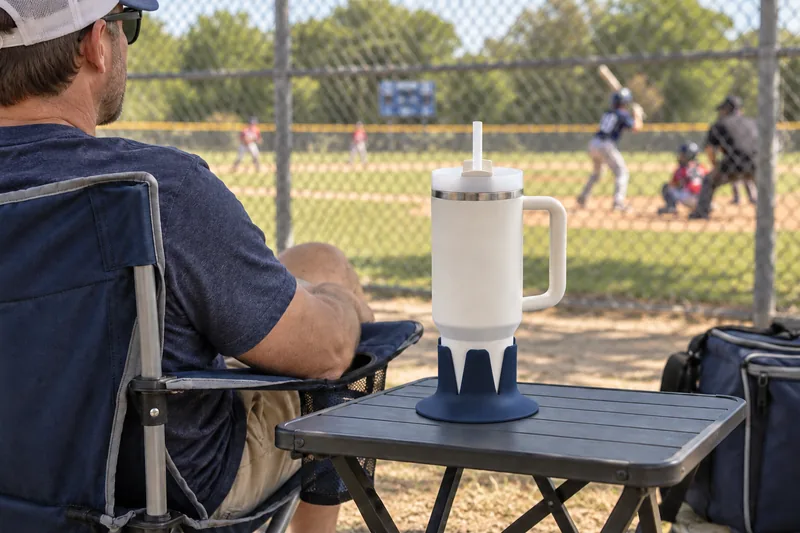
That's the category the Steadi base is in. It's one molded piece of Shore 85A TPU — not silicone, no hinge, no clamp, no spike, nothing to snap off in a wagon by June. The base is 5.2 inches across and 2.8 inches tall, and that 5.2 inches is fixed: it doesn't expand, contract or deform. The fins flex to grip the bottom inch of the container you set into it.

The mechanism is geometry, and it's worth stating plainly because most of this category oversells itself. A tall tumbler sits on a base of maybe three inches. Tip it a little and its center of mass reaches past the edge of that footprint, and over it goes. Set it into the Steadi base and the base of support is now 5.2 inches across, so the center of mass has to travel much further horizontally before it passes outside that support — which means tipping takes a substantially larger tilt than it did. The TPU's tack does the other half of the job: it resists sliding, which is exactly what a scatter of loose infill and a smooth, breezy concrete apron take away from you.

Nothing about it stakes, clamps or attaches, so there is nothing in it for a turf rule to prohibit. It sits on a bleacher plank, a cooler lid, a gravel apron or a designated turf strip the same way, and it comes up when you do.

The honest limits, because a turf complex is exactly the place where overclaiming gets caught:

Which is the odd consolation of the whole thing: the surface that takes away the wagon, the stakes, the canopy, the sports drinks and half your sideline is also the surface a sit-on-top base works best on. Flat, hard, and impossible to stake into is a bad day for most sideline gear and a good day for this one.

If you want to look at it, the maker sells it directly at steadilabs.com, with 90 days from delivery to try it on your own sideline — free returns, used is fine, which is the only version of a guarantee that means anything for something you're going to test in a gravel parking lot at 8 a.m.

Common questions about turf complexes

Can I use a stake or spike drink holder on artificial turf? No, on two counts. The stone base under the carpet won't take a point, and facility rules routinely prohibit driving stakes, pegs, posts or poles into the surface — the same rule that requires soccer goals to be sandbagged rather than staked.

Why is it water only on so many turf fields? Because turf can't absorb a spill the way soil can. Sugary drinks stay in the infill and become a cleaning job — turf builders treat drink spills as stains requiring brushing, soap and water, rinsing and drying, and facility regulations list a spill alongside vomit and blood as something that has to be removed promptly with approved cleaning solutions.

Are folding chairs allowed on turf? It varies, and you have to check. Some complexes prohibit chairs, tents and shade structures on the surface entirely; others allow bag chairs only in a designated spectator area; some allow them but require rubber tips on metal legs.

Can I bring my wagon to the field? Often not onto the turf itself. At St. Mary's County's turf fields, wagons appear by name on the list of wheeled devices not authorized on the turf surface, along with motorized vehicles, bikes, inline skates, scooters and skateboards. Plan to stage at the gate.

How hot does artificial turf actually get? Penn State researchers measured a standard green-fiber, black-rubber system at 169°F on a clear afternoon with the air at 77°F. Industry guidance puts typical clear-day maximums at 140–170°F, versus natural grass that rarely tops 85°F.

Is a turf field sloped like a grass field? Much less. Synthetic fields are usually built with about a 0.5% crown and generally no more than 1%, because they drain vertically. Grass ball fields are graded to shed water across the surface, which is why a grass sideline is a shallow ramp.

What holds a canopy down when you can't stake it? Weight. One canopy-tent maker's published guidance for a 10x10 on hard, unstakeable ground runs roughly 15–20 lb per leg in calm conditions, 40–50 lb per leg in a 10–15 mph wind, and 60 lb per leg above that — with the honest advice to take it down entirely in 30 mph winds.


The complex isn't hostile. It's just built for the field and not for you, and it isn't going to change its rules because you brought a nice tumbler. The fastest way to stop losing to it is to stop looking for a patch of ground to fix. There isn't one, on purpose. Read the one-page rules before you drive, weight whatever you can't stake, put a real lid on everything, and give every drink in camp a footprint wider than the cup it came in.

Wondering about your specific cup? The fit database has sourced base measurements for 30+ containers — Stanley, Red Bull, Yeti, and the honest no's.

Sources

  1. Lower Merion School District — Artificial-surface regulations prohibit tent pegs, stakes, poles, field marking stakes and in-ground corner markers from being used or driven into the artificial field or track; only freestanding fiel
  2. St. Mary's County Government, Maryland — Synthetic turf rules: no stakes, posts, tripods or poles of any kind driven into the surface; tents, canopies, chairs and shade structures prohibited; wheeled devices including wagons, bikes, scooters
  3. Southlake FC — Club field rules state that only water is allowed on any artificial turf field. The prohibition on installing stakes, chairs, tables, canopies or tents on the field or track appears under the rules fo
  4. Yardley Makefield Soccer — Turf field rules require parents, siblings and friends of players to remain outside the gated turf area at all times, and permit no food or drink except water on the turf field, and no gum, candy or s
  5. Athletix (tournament turf field ground rules, via TourneyMachine) — Athletix indoor turf tournament ground rules (dated 2025-01-17): no open-top drinks permitted in the fieldhouse, only fixed tops with a twist-on lid or sealed rubber lid; bag chairs permitted only on
  6. Penn State Center for Sports Surface Research — Outdoor test specimens on a crushed stone base at the Joseph Valentine Turfgrass Research Center, University Park, PA, summer 2011. June 6, 2011 (clear, sunny): green fiber with black crumb rubber rea
  7. SportsField Management — Synthetic turf best management practices: crown of about 0.5% on many professional synthetic fields with slopes generally not exceeding 1% because drainage relies on percolation; minimum infiltration
  8. Cornell University Sports Field Management — Sports-field guidance recommends measuring synthetic field hardness at least once yearly and keeping it below 150 GMAX, notes synthetic fields can be played on essentially around the clock, and that i
  9. Washington State Department of Health — Published studies report artificial turf surface temperatures ranging from 35 to 85 degrees F higher than natural grass; guidance advises removing shoes, cleats, equipment and soiled uniforms outside
  10. San Francisco Recreation and Park Department — 2025 capacity analysis: converting a single grass field to turf adds about 800 playable hours per year, a 50% increase; large athletic complexes typically gain 5,000-10,000 additional hours per year;
  11. The Motz Group — Drink spills (pop, Gatorade) on synthetic turf are classified as waterborne stains; the prescribed remedy is to brush the residue with a stiff brush, scrub with soap and water, rinse thoroughly with c
  12. InTent — Weight guidance from a canopy-tent supplier for a 10x10 pop-up on hard surfaces that cannot be staked: 15-20 lb per leg in calm conditions, 40-50 lb per leg in 10-15 mph winds, at least 60 lb per leg
  13. National Intercollegiate Soccer Officials Association (interscholastic instruction column, 2011) — NISOA interscholastic instruction column by Joe Manjone, Ed.D. (posted 2011-12-07): there must be at least 10 feet of unobstructed area around the entire soccer field; team benches and official areas
Pick a pack — ships free

Purchases go through steadilabs.com — the maker, directly.