Ships free, always · 30-day guarantee · Molded in Orange, California
The Sports Parent Cup Holder.com ← back to the sports parent page

The sports parent file

Why drinks go over at a kids' game — and what it actually takes to keep one standing through a tournament day

A youth-sports Saturday isn't one seat — it's a camp that packs up and rebuilds itself three or four times before the sun goes down, a new field or a new patch of grass at each stop, and the same problem waiting there. Here's what the ground, the bleacher plank, the chair's own cup holder, and the cooler lid actually do to a drink at a game, why the fixes parents already carry run out of road fast, and what it actually takes to hold one steady from the first pitch to the last out.

A camp that relocates, not a seat that stays put

Most places a drink has to survive, the furniture stays put. A youth-sports Saturday doesn't work that way. Small-sided soccer packs several 7v7 fields — roughly 55 to 65 yards long — side by side at one complex, so a family gets sent to field 4 for an 8 AM game and field 1 for the 10:15, hauling the whole folding-wagon camp — chairs, canopy, cooler — between them both times. Travel-ball packing guides describe the same rhythm for baseball and softball: 8 AM to 8 PM tournament days, pool play into bracket games, gear unloaded fresh wherever the bracket sends the team next.

Every one of those moves resets a drink's footing to zero. The sideline doesn't run out of a stable spot once during the day — it runs out three or four times, at whatever patch of grass, gravel, or aluminum plank the wagon stops next to. Something that only works at the first spot it's tried hasn't solved anything; it has to still work after the third relocation, not just the first.

The ground under the chair was built to drain, not to hold anything level

Ballfields and soccer pitches aren't accidentally uneven — they're engineered that way. Sports-turf guidance calls for roughly a half-percent crown on ball-field infields, steeper elsewhere, so rain sheds off instead of pooling. A sideline looks flat walking across it; it's actually a shallow ramp, and the grass on top of that ramp is clumped and torn up near the touchline, not a smooth mat. A tall drink set down there isn't resting on soil — it's balanced on a springy, sloped patch of grass blades, its center of gravity hanging out past the edge of whatever small footprint it has.

An early kickoff makes it worse before it gets better. A 7:45 first game means dew is often still sitting on that same crowned turf, so a drink gets set down on a wet slope before the field has had any chance to dry — the exact reason a drive-thru coffee ends up riding in one hand through setting up two chairs and a canopy, because there's nowhere dry or level enough nearby to put it down.

Synthetic turf trades the slope for a hot plate

Some complexes solve the mud-and-crown problem with synthetic turf, which swaps one failure for another. Penn State's sports-surface researchers have measured synthetic turf running roughly 35 to 55 degrees Fahrenheit hotter than natural grass in direct sun, with surface temperatures reaching close to 200 degrees. A drink set on that surface isn't only unsteady, it's sitting on something actively working against it, and the crumb-rubber infill sticks to anything sweating or wet that touches it. Stakes and ground spikes are typically barred on turf fields outright, which takes the one grass workaround a lot of families already know — plant it in the dirt — off the table at exactly the complexes where it would otherwise get used most.

Wondering about your specific cup? The fit database has sourced base measurements for 30+ containers — Stanley, Red Bull, Yeti, and the honest no's.

The chair's own cup holder fails at the exact second everyone stands

The quad chair almost every sideline family already owns comes with a mesh cup holder sewn into the armrest — the default answer for the obvious reason that it's already there. Gear testers who review these chairs report the same complaints across brands: the ring is shallow and tippy, too small to secure a wide-bodied bottle, stitched into a fabric armrest that flexes whenever the sitter shifts or a chair leg sinks into softer ground. The kids'-chair version is sized for a 12-ounce can, not the tumbler actually riding along now.

That design fails at the one moment a sideline can be counted on to produce: the goal, the extra-base hit, the whole row coming out of its seat at once. The armrest tilts with whoever's standing, the mesh pocket tilts with the armrest, and whatever was riding in it goes over — right as everyone on the row is watching the field instead of their own cup holder.

The cooler lid and the wagon aren't furniture, they just look like it

With no working chair holder and no level ground nearby, the cooler lid becomes the sideline's actual table — the one rigid, flat surface within reach, so snacks, phones, and drinks all end up parked there. That lasts exactly until a kid wants a drink. The cooler has to open, and everything on the lid gets swept into the grass right at halftime or the change of innings, the busiest few minutes of the day, when the whole team swarms it at once.

The wagon isn't a better stand-in. Its fabric bed sags between the frame rails once the gear comes out, so anything set inside tips rather than stands. And the team's shared water jug — the other communal drink source on the bench — usually lives on the ground with its spigot at ankle height, so cups get filled in the same low, high-traffic strip where siblings and foul balls already move.

What's already in the bag, and where it runs out of road

Some sideline parents have already tried a stake-style drink holder, the kind sold for camping and tailgating, with a spike meant to plant in the ground. Reviews describe the same pattern: it needs soft, cooperative dirt to go in at all, hardpack and gravel defeat it outright, and once planted it wobbles, tips in wind, and after a season packed away wet starts to bend and eventually rust. It's also typically barred on turf, ruling it out where the grass workaround was already off the table. Clamp-on bleacher seats solve a different problem — back support — and leave the drink question untouched; the cup still ends up on the shared plank or the footboard, same as before the seat showed up.

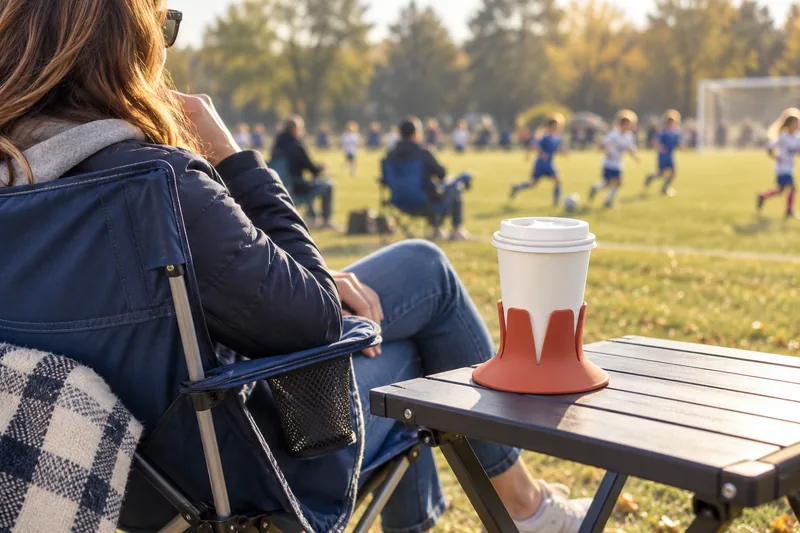
What actually holds a drink through a day built like this doesn't stake into anything or clamp onto anything, because both need one specific kind of surface and this scene hands you five different ones before lunch. A wide, flexible base spreads across the tilt instead of balancing a narrow point on top of it, and that's what resists tipping on grass, gravel, and a cooler lid alike. Flexible fins grip a container by its bottom inch, so a drink holds steady when the row jumps up together instead of coming loose with the armrest. Because the base flexes instead of standing rigid, a jostled chair leg or a bounced plank doesn't end the day — it settles the drink back level, and the next relocation starts the same way the last one ended.

That's also why the fit window is exact: a container base between 2 and 3 inches across settles in fully, and the fins flex enough to seat a snug base as wide as 3.15 inches above that — covering the 12-ounce can riding in a koozie up to the 40-ounce tumbler that's largely replaced it in the cup holders now.

None of that requires hunting a new flat spot each time the wagon moves — it requires a base that already resists tipping wherever it lands, and settles back in the next time the row jumps up to cheer.

Pick a pack — ships free

Purchases go through steadilabs.com — the maker, directly.